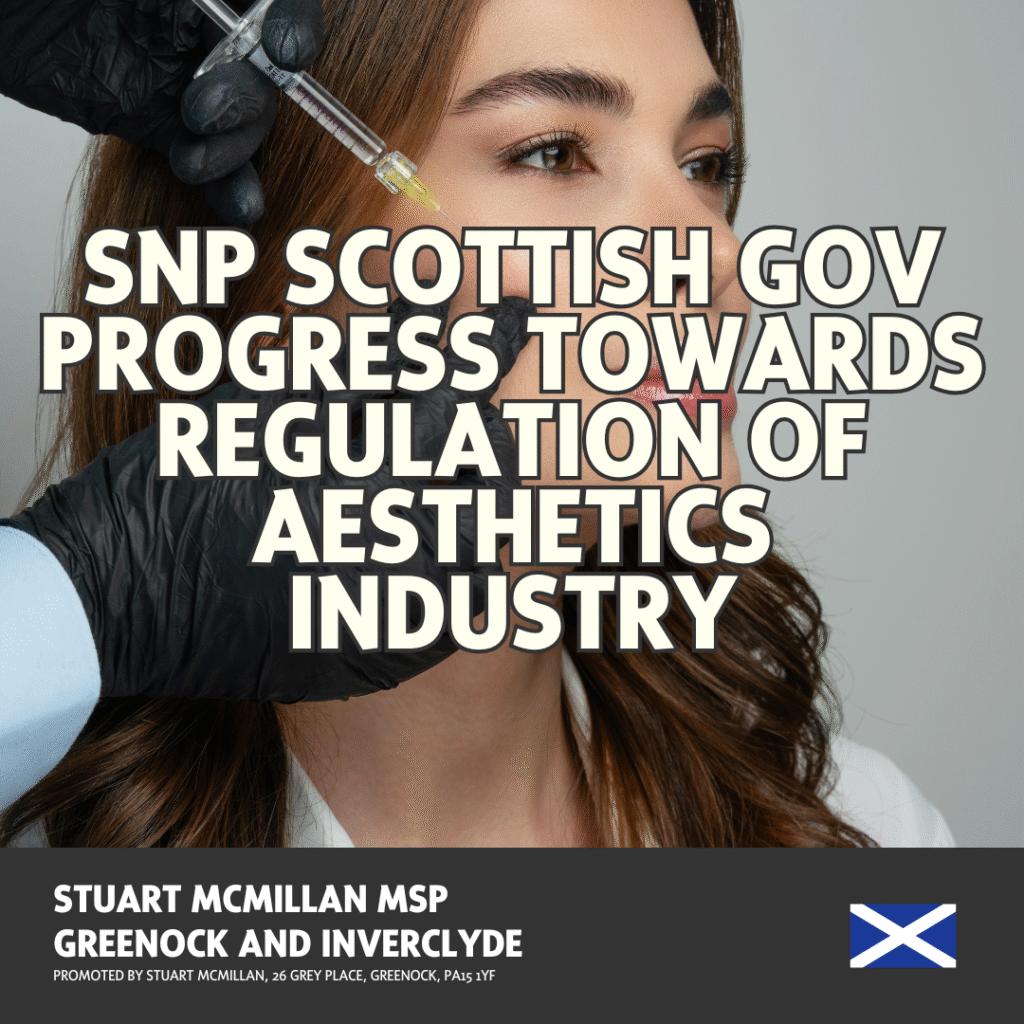
Greenock and Inverclyde SNP MSP Stuart McMillan has welcomed new proposals to improve safety and standards in the non-surgical cosmetic procedures sector – which have been set out by the Scottish Government in its response to a consultation on the issue.
The proposals, informed by over 2,200 responses and broad stakeholder engagement, intends to introduce a minimum age of 18 for all procedures and classify treatments into three distinct groups which will be regulated to reflect the associated risk:
- group 1 procedures – such as microneedling and non-ablative laser treatments – will require both a premises licence and individual practitioner licences issued by local authorities
- group 2 procedures – including injectables like Botox® and dermal fillers – will have to be supervised by a qualified health care professional in a setting regulated by Healthcare Improvement Scotland (HIS)
- group 3 procedures – for instance, breast and buttock augmentation – will have to be performed by a qualified healthcare professional in an HIS-regulated setting
The Scottish Government have committed to take forward a combination of primary and secondary legislation to implement the proposals.
This includes introducing a new Bill regulating Group 2 and Group 3 procedures – due to be published later this year – and secondary legislation under the Civic Government (Scotland) Act 1982 will establish the licensing regime for Group 1 procedures.
Commenting, Stuart said:
“I’ve been calling for legislative changes to ensure that medical aesthetic treatments, and those who offer them, are better regulated since 2018 – as public safety concerns were raised with me by those working in the sector.
“Although it’s been a long time coming, it is welcome to see the Scottish Government is acting upon those concerns as this will help reduce the likelihood of procedures going wrong.
“It has been widely reported how dangerous it can be for clients if procedures are botched – in some cases, it has sadly been fatal.
“These case studies demonstrate how invasive and technical some of these treatments are, and why ensuring practitioners are qualified and insured to administer them is vital.
“I recognise that there is some disagreement amongst the sector around the Group 2 treatments, and that is reflected in the consultation findings.
“I fully expect the Scottish Government to continue engaging with stakeholders as they seek to draft the legislation, so the right balance is struck between protecting public safety whilst also ensuring regulation is proportionate.
“I also want legislation to ensure practitioners without a medical background, but who are committed to the highest levels of care and professionalism, are supported to continue providing treatments rather than being shut out of the industry.
“This may take time to allow for adequate training and resources to be put in place, but I think it’s important that this forms part of the Scottish Government’s approach to regulating the sector.”